Business Waste Removal in Blackheath
Business waste removal in Blackheath should be straightforward, orderly and suitable for the way your premises actually operate. Our service is built around clearing commercial waste from shops, offices, studios, hospitality venues and shared workspaces, with a practical approach to sorting, lifting and removal. We handle a broad range of non-hazardous business waste and can tailor the work to suit routine clear-outs, one-off accumulations or changes to working space.
The aim is to remove unwanted material without disrupting the day more than necessary. That means planning the collection around access, separating items where needed and dealing with the waste in a way that supports reuse and recycling where practical. Clear communication matters as much as physical removal, so we keep the process simple from first enquiry to completion. If you need a quote, get in touch and tell us what needs to go.
Different businesses produce different kinds of waste, so the service needs to be flexible rather than generic. Some sites mainly need bagged rubbish removed, while others have bulky office furniture, mixed packaging or broken fixtures that need careful handling. We can work with a wide mix of commercial waste streams and remove items in quantities that suit your premises, whether that means a single load or a fuller clearance. Good disposal starts with knowing what is there, and the work is easier to plan when the waste is described clearly at the outset.
Commercial waste clearance for working premises
Business waste clearance is often needed when stockrooms, back offices, reception areas or shared facilities have become cramped with old items. The task may include bags, boxes, packaging, paperwork for disposal, worn furnishings or small fixtures that are no longer useful. We keep the service focused on removal and loading, so your team can concentrate on running the premises rather than dealing with waste logistics. Where items need to be separated for disposal, that is handled as part of the job.
For many customers, a successful clearance depends on choosing the right scope rather than over-ordering or under-ordering the work. A modest office clear-out may only need a light collection, while a larger site move could involve several categories of material. The most helpful starting point is an accurate description of what has to leave the property and how it is currently stored. Please note any access limits, such as stairs, narrow corridors or restricted loading areas, so the collection can be arranged sensibly.
When waste is mixed, we aim to separate practical material from general rubbish where this can be done without slowing the job unnecessarily. Our recycling and sustainability approach explains the broader handling of waste once it leaves the premises, including the value of sorting suitable materials rather than sending everything in one direction. That matters for commercial customers who want a tidy result and a disposal method that treats reusable items and recyclable material with care.
Office waste removal and workplace clear-outs
Office waste removal is often about restoring space and making day-to-day work easier again. That can involve broken desks, surplus chairs, filing cabinets, shelving, monitors, cardboard, general rubbish and other items that have built up over time. We remove these items in a way that suits workplaces that need to keep access routes open and common areas usable. For smaller offices, the work may be a simple collection; for larger or multi-room settings, it may need a more staged approach.
Furniture and fittings are often the biggest part of an office clearance. Tables, storage units and seating can take up space long after they have stopped being useful, especially when a business is reconfiguring rooms or updating the layout. Office clearance can cover these heavier items alongside mixed waste, helping you deal with one-off changes, end-of-lease tasks or routine refreshes without dividing the job between several providers. The result is a clearer floor plan and fewer items left for staff to manage.
Other office clearances are more about paper and contained waste than furniture. Old files, duplicated records, packaging and miscellaneous items can accumulate in cupboards or storage rooms and make the whole workspace feel cramped. A sensible clearance plan should reflect what is actually on site, not a generic list of office waste. If your business also needs confidential material dealt with separately, that can be handled as a distinct requirement rather than mixed into ordinary rubbish removal.
Furniture disposal for commercial settings
Furniture disposal is a common part of business waste removal because commercial interiors change frequently. Desks, chairs, tables, cabinets and display units can become surplus after redecoration, relocation or a simple change of layout. We remove furniture with attention to size, condition and access, since large pieces often need careful carrying through working areas or shared entrances. The service is useful when you need bulky items moved out cleanly rather than left in corridors or storage rooms.
Furniture disposal is particularly relevant when items are no longer suitable for reuse within the business but still need to be handled responsibly. Some pieces may be better kept separate from general rubbish because they can be broken down into different materials. Other items may be awkward to move but otherwise straightforward to load. Either way, the focus is on efficient removal and responsible handling rather than leaving you to decide how every component should be dealt with.
Preparation does not need to be complicated. If items are already gathered together, that makes collection simpler. If they are spread across several rooms, it helps to say so in advance. For most commercial furniture jobs, the key details are access, quantity and whether any pieces are unusually heavy or awkward. Once those points are clear, the removal can be planned in a way that suits your premises and the time available.
Waste removal for mixed commercial and light industrial waste

Waste removal in a business setting often means dealing with several materials at once rather than a single type of rubbish. Cardboard, plastics, small fixtures, packaging, bagged waste and redundant items can all build up together. Our service is designed to remove mixed waste from commercial premises efficiently, with enough flexibility to suit different kinds of workspaces. The emphasis is on practical collection, sensible loading and a finished result that leaves the area clear.
Where waste is mixed, good service depends on keeping the process organised. Items that can be sorted separately should not be left tangled with general rubbish if that can be avoided, especially when the job includes bulky items or materials with different disposal routes. Waste removal provides a broader option for businesses that need an all-round clearance approach rather than a narrow, item-specific service. It suits premises that have accumulated a varied load and want it removed in one planned visit.
Sometimes the work involves more than ordinary rubbish but less than a full premises clearance. For example, a storeroom may hold old fixtures, packaging, broken equipment casings and loose waste together. In those cases, the value of the service lies in taking the mixed material away in a structured way. That keeps back-of-house areas usable and reduces the need for staff to split the waste into separate jobs before removal can even begin.
How pricing and quotations are usually shaped
Commercial waste jobs are commonly priced around the amount and type of waste, the space it occupies, and the access conditions at the premises. A removal from a ground-floor unit with easy loading is usually different from one that involves stairs, long carries or limited parking. Heavy furniture, mixed materials and awkward items may also affect the time and labour required. The clearer the description of the waste, the easier it is to prepare a fair quotation.
Pricing and quotes is the best place to look when you want to understand how a quotation is put together before booking. For a commercial customer, that can be useful when comparing a one-off clearance with a recurring or larger-scale job. If you want an estimate, a concise description of the waste, the location within the premises and any access considerations will usually be the most helpful information to provide.
The most useful quotation requests are specific without being complicated. A quick list of item types, approximate volume and whether they are already gathered together gives a clearer picture than vague wording. If there are a few particularly heavy or awkward pieces, mention those as well. Accuracy at the beginning reduces uncertainty later and helps the work move more smoothly when the collection date arrives.
Office furniture, equipment and document-related waste
Many commercial clear-outs involve more than obvious rubbish. Businesses often need unwanted office furniture, old filing equipment, obsolete peripherals or surplus storage units removed alongside ordinary waste. Some jobs are prompted by restructuring, while others follow a room-by-room tidy-up. We can help clear these items in a way that respects the working environment and keeps the process orderly, especially where several categories of material need to be dealt with together.
If your concern includes records or sensitive paperwork, that should be separated from standard waste so it can be managed appropriately. Confidential shredding is relevant where businesses need secure treatment of documents before disposal, and it should be considered on its own merits rather than blended with general office rubbish. That distinction matters because not everything in a workplace clear-out has the same handling requirements.
For other items, the main question is whether they are to be removed intact or broken down first. Some office equipment is simple to carry but awkward in shape, while some furniture is the reverse. A good collection plan takes account of both. If you are preparing a workspace for refurbishment or reorganisation, it helps to identify what must go, what should stay and which rooms are likely to be affected so the collection can be timed and managed sensibly.
About Blackheath

Blackheath is an open, elevated area in southeast London best known for its broad common and its long association with public gatherings, sport and local movement between neighbouring districts. The heath itself is one of the most recognisable features of the area: a wide expanse of grassland that gives the place a distinctive sense of openness within the urban landscape. To the south-east lies Greenwich Park, while the built-up edges around the heath include a varied mix of residential streets, civic buildings and local shops. Blackheath station, which opened in the 19th century, forms part of the transport fabric that connects the area with central and wider London. The locality also sits close to historic Greenwich, with the Royal Borough’s architectural and cultural landmarks contributing to the wider setting. Around the heath, mature trees, period houses and village-style streets create a strong visual contrast with surrounding roads. The area has long been associated with meetings and public assembly, and its open ground has helped preserve a character that feels different from denser nearby districts. Local landmarks include Blackheath Halls, an established arts venue with a longstanding role in the neighbourhood’s cultural life, and the variety of churches, schools and community spaces that line the roads around the common. In spring and summer, the open ground is used by walkers, runners and informal visitors, while the surrounding streets retain a quieter, residential atmosphere. The historic layering of open space, transport links and local institutions gives Blackheath a clear identity within southeast London, with the heath remaining at the centre of both its geography and its name.
Clearance for garages, storage rooms and ancillary spaces
Garages, storerooms and other back-of-house spaces are often where business waste ends up when it is no longer needed but has not yet been removed. These areas can contain mixed items such as broken equipment, redundant packaging, old shelving, offcuts and general rubbish. Our approach is to clear these spaces systematically so the area can be used again, rather than simply moving waste from one corner to another. That makes the service useful when you need a practical reset, not just a temporary tidy.
Garage clearance is a helpful option where the waste is concentrated in an ancillary space and includes bulky or awkward items alongside lighter material. In business premises, those areas are often used for overflow storage, so the content may be more mixed than in a standard office room. Clearing them properly can reveal what should be kept, what should be recycled and what can leave the site in one organised load.
Spaces like these often become catch-all rooms for items that are too inconvenient to sort during the working week. The job is therefore less about decoration or deep cleaning and more about restoring usable floor area. If access is restricted or the room contains items that must be handled carefully, those details matter. With a clear description, we can approach the clearance in a way that avoids unnecessary handling and keeps the job focused.
Recycling, reuse and responsible disposal choices
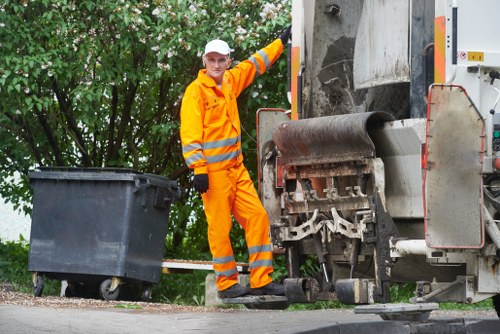
Responsible commercial waste removal is not just about taking items away; it is also about deciding which items can be directed into the most suitable route. Some materials are best kept separate because they may be recyclable, while others may be suitable for reuse or require ordinary disposal. We treat those decisions as part of the service, not as an afterthought. That is especially important where businesses want their waste handled in a controlled, practical way.
Recycling and sustainability outlines the wider approach to waste handling and the value of keeping usable material out of the general waste stream where possible. Commercial customers often appreciate a straightforward explanation of how mixed loads are dealt with, particularly when the clearance contains furniture, packaging and other material that does not belong in a single category. A sensible disposal process supports tidier premises and more organised waste handling.
If you are arranging removal for a busy site, it can help to think about the final destination of the waste in broad terms rather than trying to classify every item yourself. The practical step is to describe what you have, and then let the collection be organised from there. That keeps the process manageable and avoids unnecessary delay. When you are ready, request a quotation and share the details that matter most.
Business waste removal that fits your premises
Every business premises has different constraints, so waste removal works best when it is matched to the layout and the kind of material involved. An office with light everyday waste will have different needs from a shop fitting out a back room or a company clearing stored furniture. We aim to keep the service adaptable, with a focus on getting the waste out cleanly and leaving the premises in better working order. That practical flexibility is often what commercial customers need most.
For larger or more mixed clearances, the best results come from a simple plan. Identify the main items, note any access considerations and say whether the waste is grouped together or spread across several spaces. That information is usually enough to start without turning the process into a long checklist. If you want to move ahead, use the contact route on the site and ask for a quote for the work you need.
Whether the task is a compact office clearance, a mixed waste collection or the removal of surplus furniture from a business unit, the aim is the same: an orderly clearance that suits the pace and shape of the premises. If you need help with business waste removal in Blackheath, send your details for a quotation and we can look at the most suitable way to handle the load.